 Skip to content
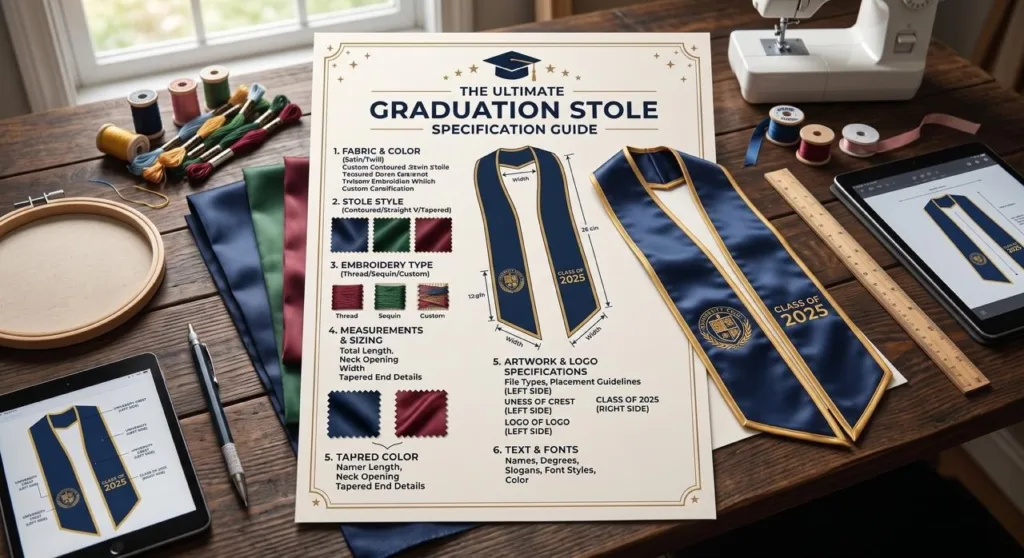
A graduation stole specification sheet should define exactly what the buyer expects the supplier to quote, produce, inspect and pack. At minimum, it should include the product style, finished dimensions, fabric, color, construction, decoration method, artwork placement, quantity by design, packaging, labeling, quality checkpoints and approval status. It should also show the document owner, revision number and approval date.
This document is especially useful for schools, universities, graduation committees, distributors and resellers. It turns scattered emails and artwork files into one controlled order reference. As a result, buyers can compare quotations more fairly, while suppliers can identify missing information before production begins.
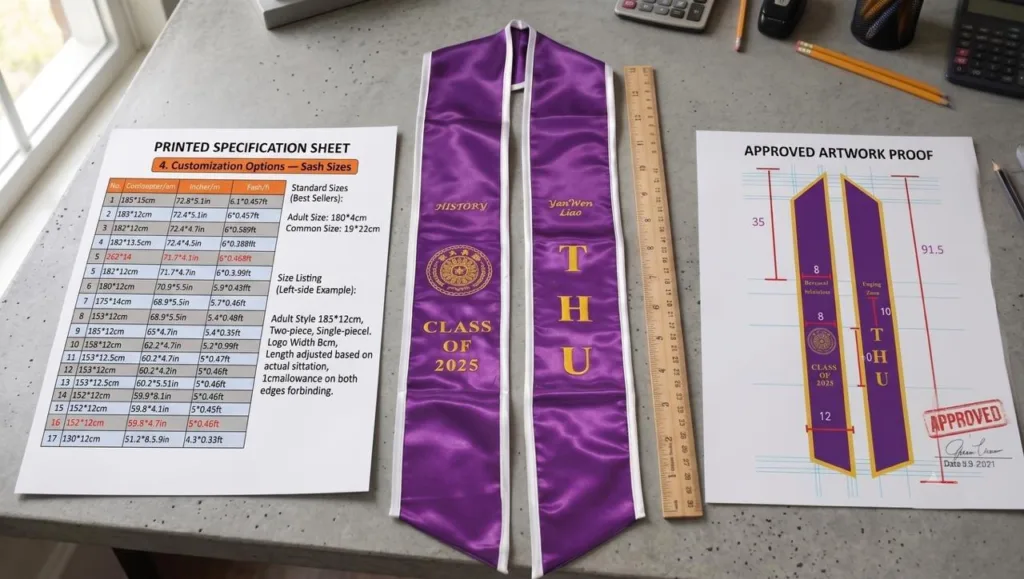
1. Start with project and document control information
A specification sheet needs a clear identity. Otherwise, teams may confuse one ceremony, department or artwork version with another. Put the following information at the top of the document:
- project or purchase reference;
- school, organization or buyer name;
- supplier name;
- ceremony or campaign name;
- required delivery date and destination;
- document owner and final approver;
- specification revision number;
- issue or approval date; and
- linked artwork file names and versions.
Revision control matters when several people review the order. For example, a department may change the graduation year after the first proof. If the specification sheet still points to the older file, the supplier may receive conflicting instructions. A simple revision table can show what changed, when it changed and who approved it.
The sheet should also identify the product category. Buyers who need an undecorated base can review custom plain graduation stoles. The final specification should still state whether the item will remain plain or receive decoration later.
2. Define the physical stole clearly
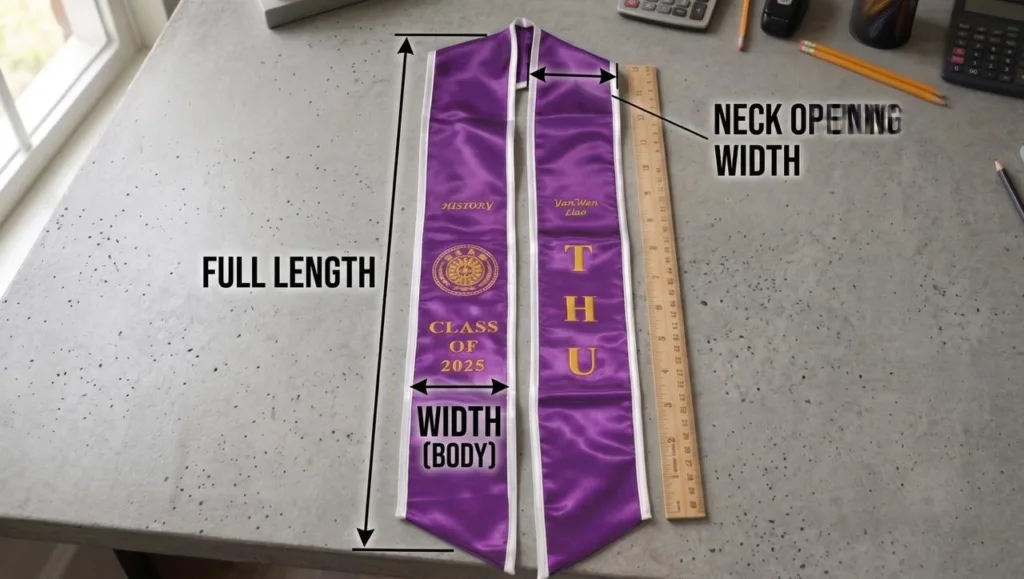
Product photographs help with visual discussion, but they do not establish finished dimensions or construction. Therefore, the specification sheet should describe the physical stole in measurable terms.
Include these fields when they apply:
| Specification field | What to record |
|---|---|
| Product style | V-shaped, straight, trimmed or another approved construction |
| Finished length | State the measurement method and unit |
| Finished width | State where the width is measured |
| Size group | Adult, youth, child or a buyer-defined size |
| Fabric | Confirm the material description with the supplier |
| Fabric finish | Matte, sheen or another approved appearance |
| Color | Supplier color, buyer reference or approved sample |
| Edge finish | Hem, trim, piping or another construction detail |
| Back or neck shape | Describe the approved form if relevant |
| Special features | Layers, pockets, fasteners or other requested details |
Do not leave units implicit. Write inches or centimeters beside every dimension. In addition, include a diagram showing where each measurement starts and ends. This prevents two teams from measuring the same stole in different ways.
If the buyer has a reference sample, the sheet should record whether that sample controls size, color, feel, construction or only general appearance. A sample should not silently override the written specification.
3. Record the decoration method and artwork placement
Decoration is one of the most common sources of misunderstanding. “Add our logo” does not explain the production method, size, location or orientation. The specification sheet should connect each design element to a defined panel and artwork file.
For every logo, line of text or symbol, record:
- decoration method;
- left or right panel location;
- distance from an agreed reference point;
- maximum artwork width and height;
- orientation when the stole is worn;
- thread or print color reference;
- font or outlined artwork file;
- approved wording, spelling and year; and
- whether the design repeats on both sides.
Buyers can compare custom printed graduation stoles with custom embroidered graduation stoles before finalizing the method. Printing can suit detailed or color-rich graphics, while embroidery can create a raised decorative finish. However, the buyer should confirm method suitability for the specific artwork, size, fabric and budget.
Artwork files should use clear names. For instance, Nursing_Stole_LeftPanel_R03.pdf is safer than final-logo-new.pdf. The specification sheet should list the exact approved file. It should also identify the person authorized to approve the proof.
A digital proof can confirm layout, wording and placement. However, screen color may differ from fabric, thread or printed output. When exact color is critical, both parties should agree on a practical approval reference before production.
4. Separate quantities, variations and personalization data
A bulk order often contains more than one design. Different departments may use different colors, years, logos or student names. Therefore, the specification sheet needs a quantity breakdown instead of one total figure.
Use one row for every variation:
| Variant ID | Style/size | Color | Artwork version | Personalization | Quantity |
|---|---|---|---|---|---|
| Example A | Adult / approved size | School color 1 | ART-A-R03 | None | To confirm |
| Example B | Adult / approved size | School color 2 | ART-B-R02 | Program name | To confirm |
Label examples as examples; do not leave them in the final order table. The approved sheet should contain the actual quantities and files.
For personalized orders, keep names and individual details in a separate controlled data file. The specification sheet should reference that file and define:
- column names and required format;
- spelling and capitalization rules;
- character or layout limits;
- duplicate-name handling;
- blank-field handling; and
- the deadline for final data approval.
The buyer should also explain whether extra units are required for late changes, replacements or ceremony-day contingencies. Any extra quantity must appear in the approved order instead of relying on an informal expectation.
5. Add inspection points and acceptance criteria
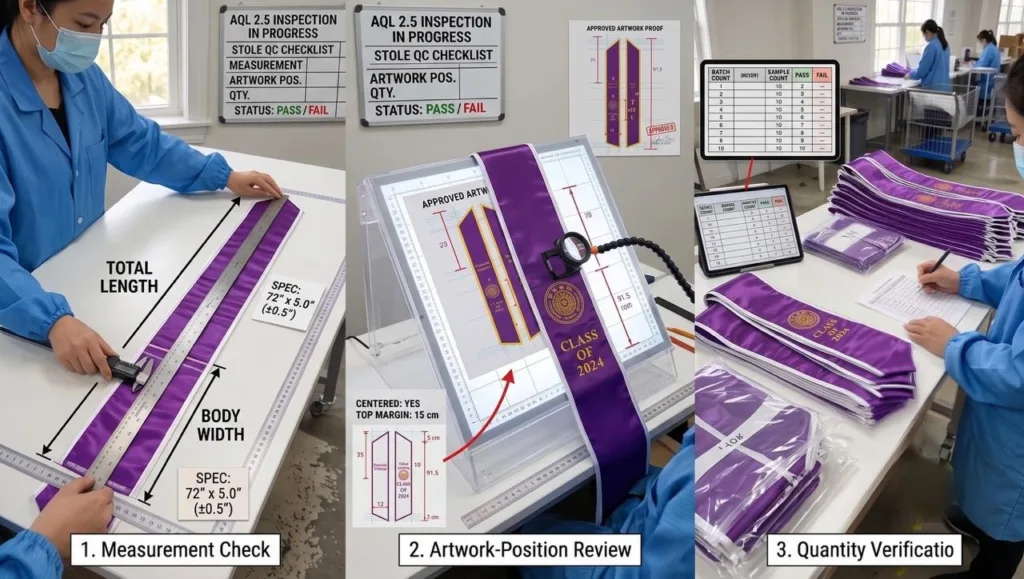
A specification sheet becomes more useful when it supports quality inspection. Avoid vague instructions such as “good quality” or “perfect logo.” Instead, list the features that the supplier can see, count or measure.
Possible checkpoints include:
- finished length and width;
- correct style, fabric and color reference;
- approved artwork file and decoration method;
- logo size, position and orientation;
- spelling, dates and program names;
- sewing, edge finish and visible cleanliness;
- quantity for every design variation;
- included packaging and labels; and
- function or durability checks agreed for the exact product.
The buyer and supplier should define any tolerance before production. The same rule applies to sampling. State whether approval requires a digital proof, physical sample, decoration sample or another agreed reference.
Inspection evidence may include overall product photos, close-ups, measurements, variant counts and packing images. However, the available evidence should be confirmed for the order. Factory photos do not replace a formal third-party inspection when the contract requires one.
6. Specify folding, packaging and carton labels
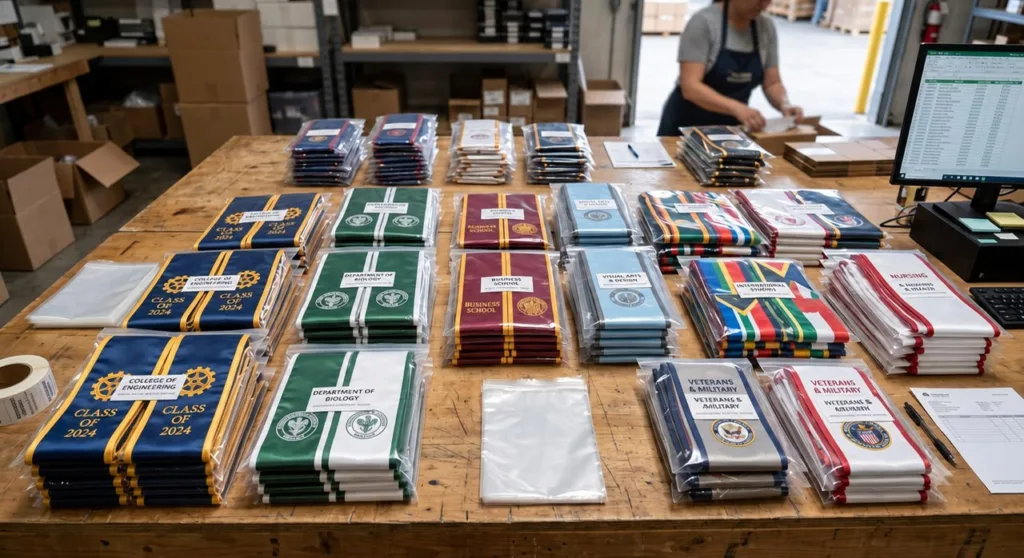
Packaging affects storage, distribution and ceremony-day preparation. A school may need individually packed stoles, while a distributor may need retail-ready packaging or grouped cartons. The specification sheet should define the required arrangement.
Useful packaging fields include:
- individual or bulk packing;
- folding method;
- protective bag requirements;
- insert, barcode or product label;
- units per inner pack and carton;
- carton grouping by program, color or location;
- shipping marks;
- carton list requirements; and
- privacy rules for personalized items.
When one order serves several campuses or departments, carton labels should match the buyer’s distribution plan. Clear labels can reduce sorting work after delivery. In addition, the receiving team should know which carton contains each variation.
7. Connect the specification sheet to the order process
The specification sheet is not a replacement for a quotation, artwork proof, purchase order or contract. Instead, it connects those documents.
A practical approval sequence is:
- the buyer issues the draft specification;
- the supplier identifies missing or conflicting details;
- both sides confirm the quotation assumptions;
- the buyer approves the artwork proof or sample plan;
- both sides lock the final specification revision;
- production follows the approved documents; and
- inspection compares the order with the same revision.
If a change occurs later, record it in a new revision. Do not overwrite the file without documenting the change. Buyers can use Sashesmaker’s bulk graduation stole procurement checklist to connect the specification sheet with quantity planning, supplier comparison, approval and shipping preparation.
Graduation stole specification sheet checklist
Before sending the document for quotation or approval, confirm that it includes:
- project name, buyer and delivery requirement;
- product style and size group;
- finished dimensions with measurement points;
- confirmed or to-be-confirmed fabric and color;
- edge, trim and construction details;
- decoration method for each design element;
- artwork file name, version, size and placement;
- quantity by color, size and design;
- personalization data reference;
- inspection points and agreed tolerances;
- proof or sample approval requirement;
- folding, packaging and labeling instructions;
- revision number, approval owner and approval date; and
- list of unresolved items before production.
Frequently asked questions
Is an artwork proof the same as a specification sheet?
No. The artwork proof shows the visual layout. The specification sheet also records dimensions, fabric, construction, quantity, inspection, packing and document control. The two files should reference each other.
Should a specification sheet include a fabric weight or material composition?
Include these fields when they matter to the order, but record only supplier-confirmed values. Do not copy an assumed material or weight from a similar product.
How should schools manage several stole designs in one order?
Give every variation a unique ID. Then list its size, color, artwork version, personalization rule and quantity in a variation table. Use the same ID on packing lists and carton labels.
What happens if the design changes after approval?
Issue a new specification revision and update the linked artwork version. Record the change, date and approver. The supplier should confirm any effect on price, schedule or completed work.
Can the same specification sheet be used to compare suppliers?
Yes. Sending the same controlled requirement to each supplier supports a more accurate comparison. Still, buyers should review each supplier’s assumptions, exclusions, sample policy, inspection scope and shipping proposal.
Prepare a clearer graduation stole quotation request
A complete specification sheet helps Sashesmaker understand the product, artwork, quantity and delivery requirements. It also makes unresolved decisions visible before production.
To discuss a custom project, send your graduation stole requirements to Sashesmaker. Include the draft specification, artwork files, quantities, destination and required arrival date.
