
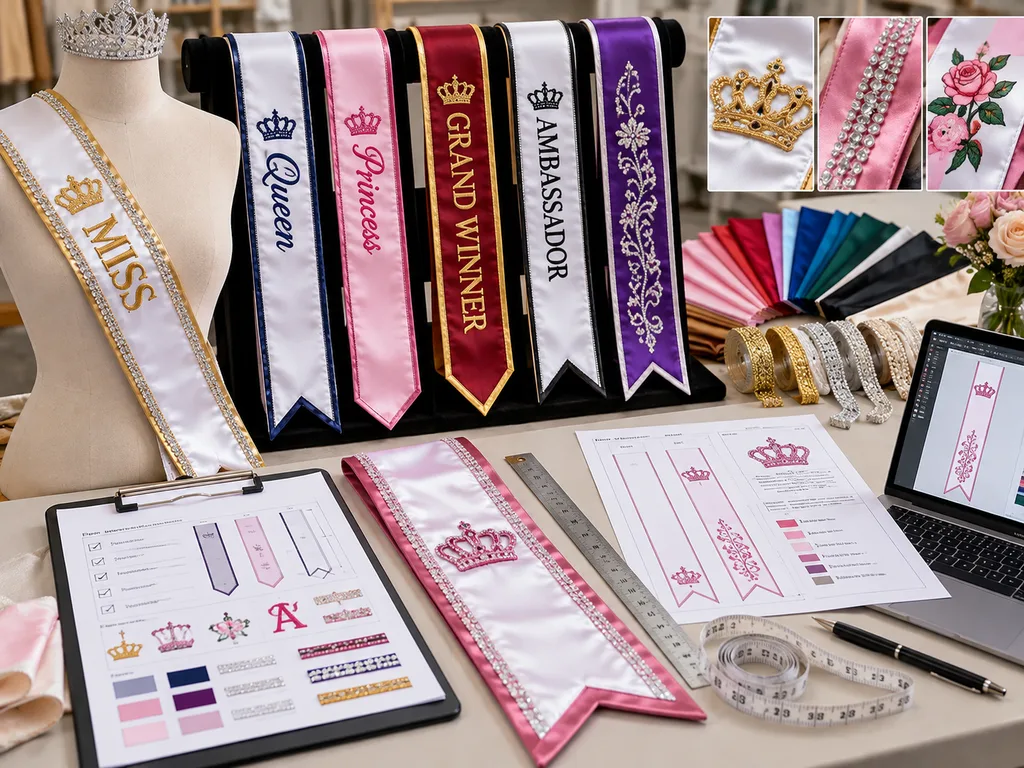
Before ordering custom pageant sashes, buyers should define the wearer, finished dimensions, construction, fabric, color, text, decoration method, closure, packaging, quantity by design, approval process, and required delivery date. Put every approved choice into one specification sheet. A logo file or reference photo alone is not a production specification.
The questions below help pageant organizers, award programs, event agencies, brands, and distributors turn a visual idea into an order that can be quoted, sampled, inspected, and repeated.
What information should be fixed before asking for a quote?
Start with the event and order structure. Tell the supplier whether all sashes share one design or whether titles, names, colors, or sponsor logos vary by wearer. These details can affect artwork, production handling, packing, and minimum quantities.
Send the following information in the first request:
- Event type, wearer group, and intended wearing conditions.
- Total quantity and quantity for every title, color, or logo version.
- Required delivery location and the date goods must arrive there.
- Reference images, draft wording, logos, and brand color references.
- Preferred fabric, shape, decoration, closure, and packaging.
- Whether a digital proof, physical sample, or both must be approved.
Request an itemized quotation stating inclusions, setup or variation charges, the freight basis, and any specifications still subject to confirmation.
Which sash measurements must be specified?
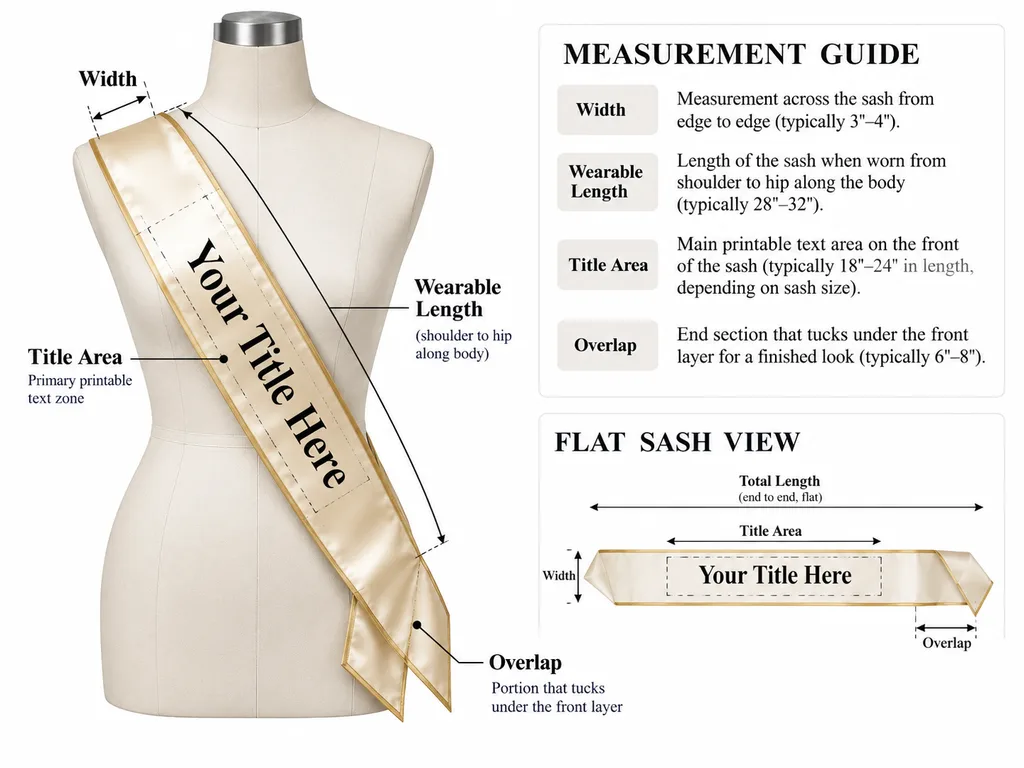
Specify finished measurements and the supplier’s measurement method. Terms such as adult, child, standard, or queen size are not precise enough for production.
Ask these questions:
- What is the finished sash width at the visible front?
- Is length measured end to end before closure, around the wearable loop, or from shoulder to opposite hip?
- How much overlap is allowed at the closure?
- Where should the title begin and end on the wearer’s front?
- Does the order include different sizes for adults and children?
- What finished tolerance will be used, and how will it be checked?
A fit sample should be worn over the clothing expected at the event. If one size must serve several body types, test the intended range rather than relying on one person.
Which shape and construction should buyers choose?
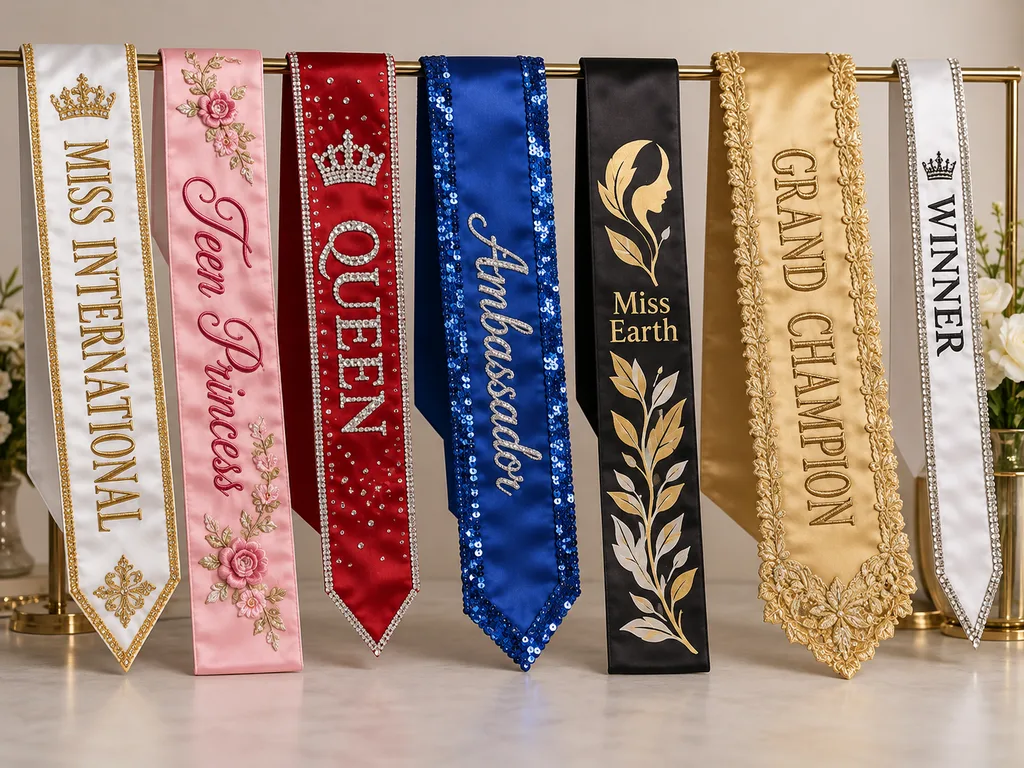
The shape controls how the sash sits, where the wording remains visible, and how the ends meet. Sashesmaker’s public pageant sash product page currently shows one-piece, two-piece, flat, and slant options. Buyers should still request diagrams or samples because category names may not define the same construction at every supplier.
| Specification question | Why it matters | What to record |
|---|---|---|
| One piece or joined construction? | Changes seams, drape, and printable area | Approved construction drawing |
| Straight or shaped shoulder area? | Affects fit and text angle | Shape name plus image or template |
| Flat or slanted presentation? | Changes how titles read when worn | Wearing orientation and front side |
| Open ends or permanent loop? | Determines closure and adjustability | End finish and closure method |
| Lined or unlined? | Changes body, opacity, and finish | Layer construction and approved sample |
Also state seam position, edge finish, and the front side. For trim or accessories, specify material, width, color, placement, and attachment method.
What fabric and color questions prevent mismatched expectations?
Confirm the fabric by more than a marketing name. “Satin” describes a surface appearance or weave category, but it does not by itself define fiber content, weight, thickness, stiffness, opacity, or sheen.
Ask the supplier to state fiber composition, color option, surface finish, and whether the sample represents bulk material. Check light colors for opacity and review glare and legibility under expected lighting.
Name the physical swatch, supplier color card, or color system that controls approval. A screen image should not be the sole standard for a color-critical order. Record the agreed reference and acceptable variation.
Sashesmaker says its pageant sashes use satin and offers standard colors plus custom Pantone-referenced colors. That statement describes available inquiry options, not automatic confirmation that every material, quantity, or decoration can use a custom color. Confirm feasibility, minimum quantity, and sample conditions for the exact order. Source: Sashesmaker pageant sashes, accessed October 16, 2026.
How should titles, names, and logos be specified?
List every unique sash as structured order data. A spreadsheet is safer than copying titles from email messages because it can assign one row to each wording, size, color, logo, and quantity combination.
For all text, confirm:
- Exact spelling, capitalization, punctuation, and year.
- Font name or approved outlined artwork.
- Text direction and reading orientation when worn.
- Maximum artwork area and distance from seams and edges.
- Title alignment, line breaks, and hierarchy.
- Whether the same title appears on one side or both sides.
For logos, provide editable vector artwork when possible plus a reference PDF. Identify required clear space and minimum readable size, and confirm permission to reproduce submitted marks.
Assign each variation an identifier such as SASH-001 and use it on the proof, purchase order, production list, and packing list. This reduces mismatches between wording, color, and size.
Which decoration method suits the design?
Choose the method after reviewing artwork complexity, required appearance, fabric behavior, order size, and budget. Sashesmaker publicly lists gold and silver foil printing, general printing, and embroidery among its pageant sash options. Buyers should compare actual samples made on the proposed fabric before approving a method.
| Decoration option | Ask the supplier to confirm | Sample checks |
|---|---|---|
| Foil | Available colors, fine-detail limits, placement, adhesion criteria | Voids, edges, cracking, transfer marks |
| Printed graphic | Color process, white ink if relevant, artwork resolution, print area | Legibility, registration, opacity, surface feel |
| Embroidery | Thread colors, stitch area, backing, minimum detail, reverse-side finish | Distortion, puckering, loose threads, small-text clarity |
| Applied accessories | Material, placement, attachment, garment-care limits | Security, alignment, snag risk, consistency |
Define the desired result instead of asking for “the best” method. Metallic shine, photographic color, raised texture, and fine lettering require different solutions. For combined methods, approve the application sequence.
What closure and wearing details should be agreed?
The closure should keep the sash in position without distracting from the presentation. Ask whether the proposed solution is a pin, hook-and-loop fastener, snap, sewn join, ribbon tie, or another construction. Confirm whether hardware is supplied attached, supplied loose, or excluded.
Review the closure from the front and back. Ask whether it is adjustable, can contact skin or delicate garments, or requires assistance. For children’s products, obtain an appropriate safety review for the intended market and event.
If the sash must remain flat for photography, state whether the organizer will use temporary fastening or garment tape.
What should the artwork and sample approval process include?
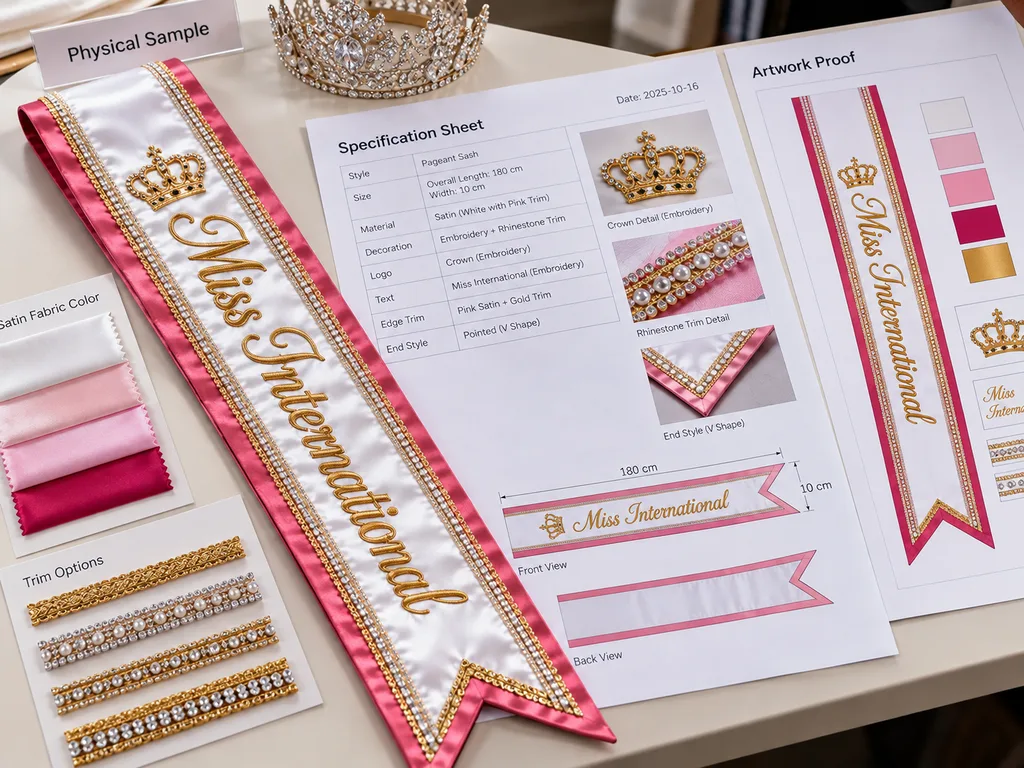
Approval should lock one identifiable revision. A digital proof can confirm wording, layout, orientation, and assigned color references, but it cannot prove fabric hand, drape, sheen, physical color, or decoration adhesion.
Use this sequence:
- Submit the specification sheet, variation list, and source artwork.
- Review a digital proof carrying a revision number and date.
- Request a production-representative physical sample when fit, material, color, or decoration risk justifies it.
- Record corrections and require a revised proof rather than approving changes described only in chat.
- Approve one final revision in writing and prohibit unapproved substitutions.
Keep the approved sample and files. For repeat orders, reconfirm material availability, color, artwork version, and timing.
Which quality-control and packaging questions belong in the order?
Define acceptance before production. “Good quality” is not measurable. The purchase order should identify the characteristics to inspect, how measurements are taken, and the agreed response if goods do not match the approved specification.
At minimum, ask how the supplier will check:
- Quantity by SKU and title.
- Finished width, length, shape, and closure position.
- Fabric color, visible marks, seams, and edge finish.
- Spelling, logo version, decoration position, and legibility.
- Foil, print, embroidery, or accessory workmanship.
- Individual packaging, labels, assortment, and carton markings.
State whether each sash needs an individual bag, SKU label, wearer name, visible title, or event-level sorting. Personalized orders should be packed in a sequence the event team can verify quickly.
Sashesmaker’s page describes artwork confirmation, material selection, decoration, sewing, quality inspection, and packaging as process stages. Use that sequence to ask for order-specific evidence and checkpoints; the public description is not a substitute for an agreed inspection plan. Source: Sashesmaker pageant sashes.
How should MOQ, timing, and delivery be confirmed?
Ask what the minimum order quantity applies to: the full order, each color, each shape, each title, or each packaging version. Sashesmaker’s pageant sash page currently states that MOQ starts from 200 pieces. Treat this as a public starting point and obtain written confirmation for the proposed mix of designs and quantities.
Build backward from the required arrival date. Separate artwork, proofing, sampling, production, inspection, packing, dispatch, transit, customs where applicable, receiving, and event distribution. Production time is not warehouse delivery time.
Confirm the shipping basis, destination, carton estimate, documents, and responsibility for import-related costs. Leave time for corrections and receiving.
What are the most common specification mistakes?
The most common mistakes are preventable:
- Using only a reference photo: add measurable dimensions, materials, artwork, and construction details.
- Calling every sash one design: list each unique title, color, size, and logo combination.
- Approving from a screen alone: use a physical sample when material, fit, or color is critical.
- Leaving orientation unclear: show the sash on a body diagram and mark the wearer’s left and right.
- Treating a headline MOQ or lead time as an order promise: obtain project-specific written confirmation.
- Changing wording after approval: control revisions and assess the cost and schedule impact before accepting changes.
Frequently asked questions
What is the most important pageant sash measurement?
There is no single universal measurement. Finished width, wearable length or circumference, overlap, and text position work together. Record the supplier’s exact measurement method and approve fit on the intended clothing.
Is a digital proof enough for a custom sash order?
A digital proof can approve content and layout, but it cannot validate physical fabric, color, drape, fit, or decoration performance. Request a production-representative sample when those variables create material risk.
Can every contestant title count toward one MOQ?
Possibly, but only the supplier can confirm the rule for the proposed order. Ask whether the minimum applies to total pieces, each construction, each color, or each artwork version and whether variation charges apply.
Should pageant sashes be packed by title or by size?
Use the sequence that best supports event distribution. For personalized programs, a unique SKU linked to wearer, title, size, and package label is usually easier to reconcile than loose bulk packing.
What should buyers send to request a reliable quotation?
Send the quantity by variation, required arrival date, destination, finished measurements, construction, fabric and color reference, artwork, decoration method, closure, packaging, and desired proof or sample process.
What is the next step before ordering?
Convert the answers above into one controlled specification sheet and variation list. Then ask the supplier to return an itemized quotation, production drawing, approval schedule, and order-specific minimum quantity. Buyers can send their brief, artwork, quantities, and delivery destination through Sashesmaker’s contact page to discuss a pageant sash project.