
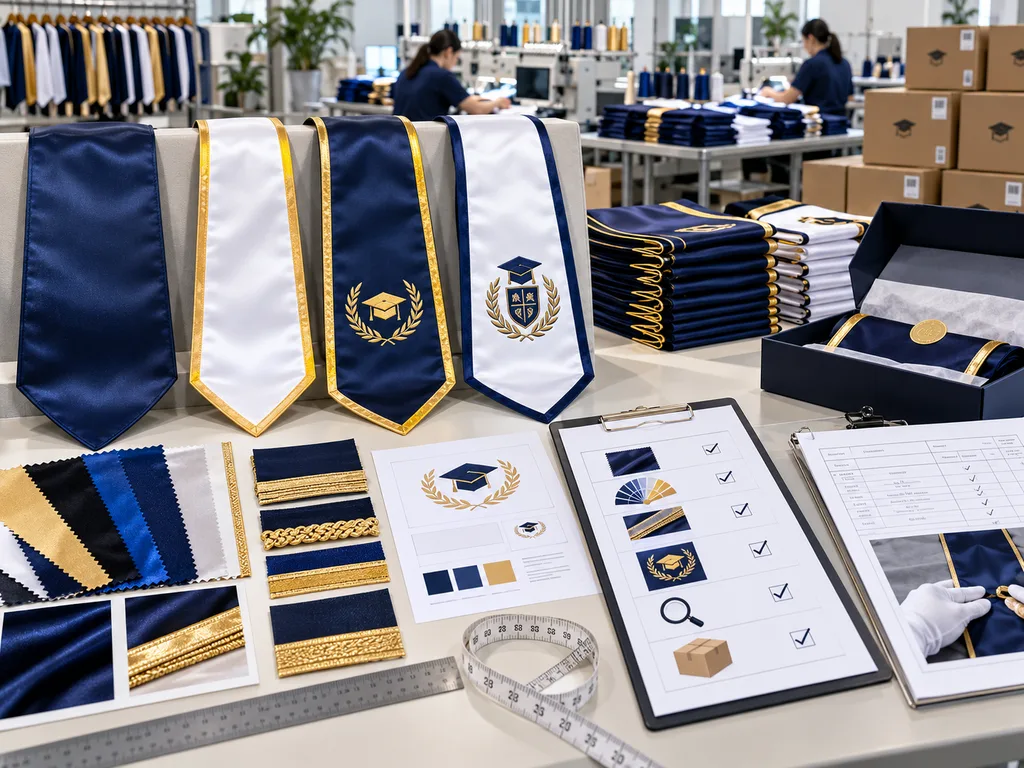
Before choosing a custom graduation stole manufacturer, verify three things: who will be responsible for the order, whether the supplier can reproduce the approved product, and whether the commercial terms protect your event deadline. Check company identity, relevant production capability, specifications, samples, quality controls, capacity, packaging, delivery scope, and defect handling. Then confirm performance through a controlled trial order before increasing volume.
A polished website or low quotation can support a shortlist, but neither proves repeatable production. Combine documents, product evidence, and observed order performance.
What evidence should buyers collect first?
Use three evidence levels instead of treating every supplier statement equally:
- Declared evidence: website pages, catalogs, quotations, and sales explanations show what the supplier claims.
- Documented evidence: registration details, specifications, dated certificates, process records, sample reports, and written terms make claims easier to verify.
- Demonstrated evidence: an approved sample, trial order, inspection result, accurate packing, and on-time communication show how the supplier performs on your product.
Declared evidence supports discovery, documented evidence supports due diligence, and demonstrated evidence supports scaling. One successful sample still cannot guarantee every future batch.
| Area to verify | Useful evidence | What the evidence does not prove by itself |
|---|---|---|
| Company identity | Registration record, legal name, business address, domain email | Product quality or financial stability |
| Manufacturing capability | Current equipment video, process map, production sample | Available capacity for your required dates |
| Product quality | Approved sample, specification, inspection record | Consistency across an uninspected bulk order |
| Compliance claim | Full certificate or test report with scope and dates | Coverage of products, sites, or batches outside that scope |
| Delivery ability | Written schedule, packing plan, shipping basis | Arrival if approvals, production, or transit change |
How can you verify the supplier’s identity and responsibility?
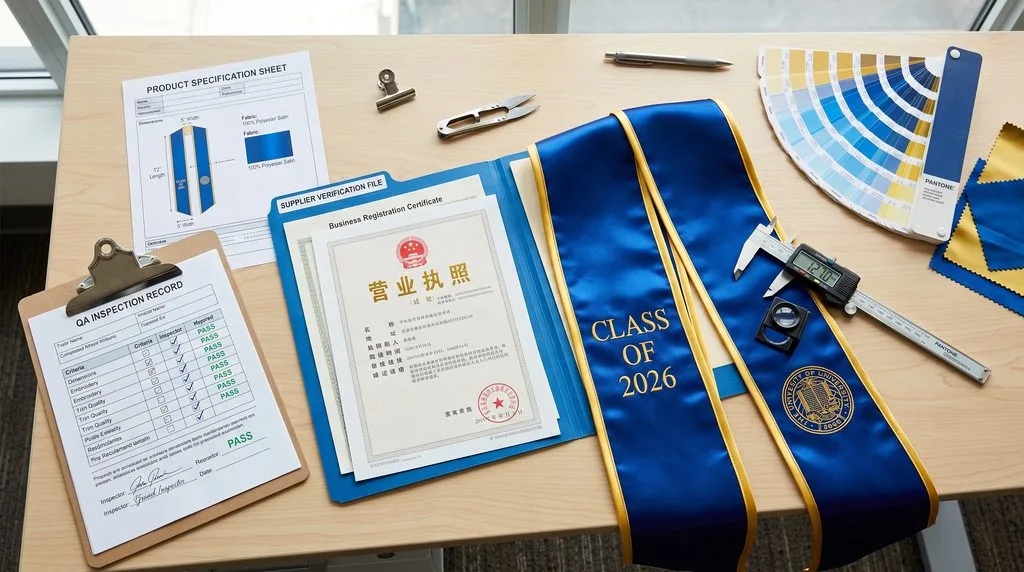
Match the legal entity, trading name, website, quotation, invoice, bank beneficiary, and contract. Differences are not automatically improper, but the supplier should explain the relationship in writing before payment.
Ask for the registered company name, registration number, operating address, factory address, and the person authorized to approve commercial terms. Confirm whether the seller is the manufacturer, a trading company, or a group company using another factory. If subcontractors handle printing, embroidery, sewing, or packing, identify who controls specifications, inspections, corrections, and confidential artwork.
Use independent registries appropriate to the supplier’s country. A video call can support, but not replace, entity checks. Verify payment-detail changes through a previously confirmed channel.
Does the manufacturer have the right production capability?
Evaluate capability against the exact stole you plan to buy. A supplier that produces plain satin stoles may not have the same controls for embroidered logos, edge-to-edge printing, Kente-style patterns, trim, or individual names.
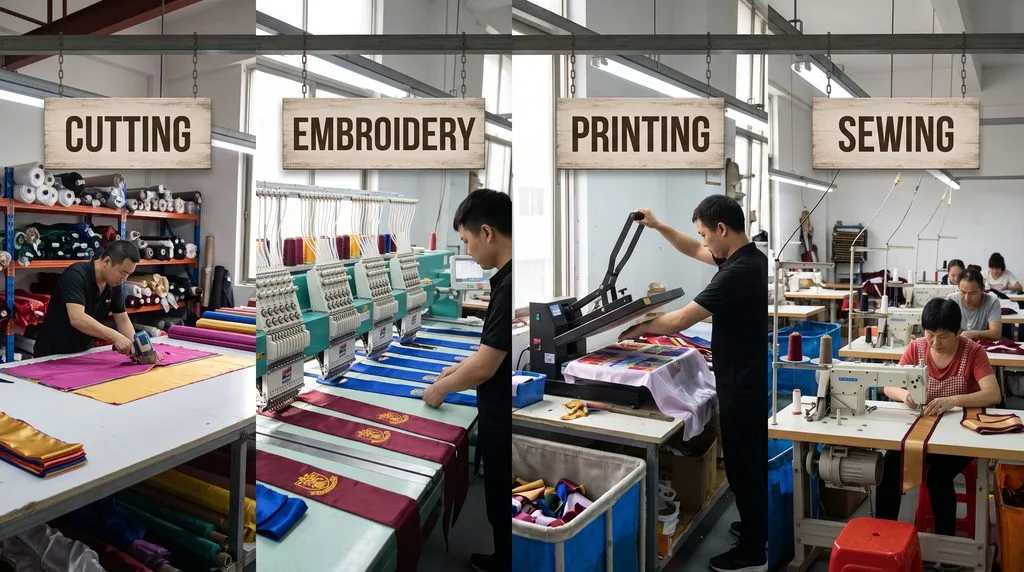
Request a process map from incoming material to packing. Identify in-house and subcontracted operations, proposed equipment, and quality checkpoints. Review recent examples using comparable material, shape, decoration, and detail.
Sashesmaker’s public website states that printing, embroidery, cutting, and edge finishing are handled in-house. Its product pages separately describe workflows for printed graduation stoles and embroidered graduation stoles. These pages show claimed capabilities and relevant questions to ask; buyers should verify the proposed production route for their own order. Sources accessed October 21, 2026.
Can the supplier turn your request into a controlled specification?
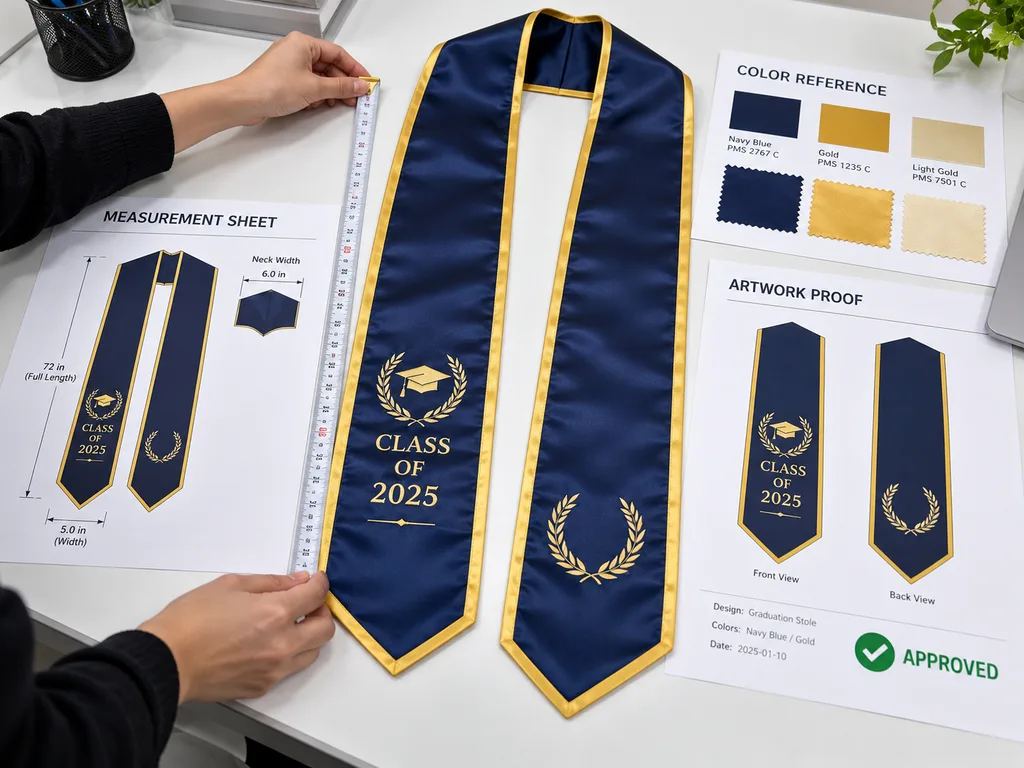
A capable manufacturer should convert a reference image into measurable requirements. The final specification should identify fabric, stated fiber composition, color reference, finished dimensions, end shape, seam and edge construction, decoration method, artwork size, placement, orientation, packaging, and quantity by variation.
Ask the supplier to mark unresolved choices before quoting. Also ask how dimensions are measured and which tolerances apply. “Standard size,” “premium satin,” “logo included,” or “same as photo” leaves too much room for interpretation.
Require a revision-controlled artwork proof and order matrix for names, years, colors, and SKUs. Use the same revision on production, approval, and inspection records.
What should a production-representative sample prove?
The sample should test the highest-risk characteristics, not merely provide a general impression. Use the proposed fabric, construction, decoration process, thread or ink system, and packaging whenever practical.
Check the sample for:
- Finished length, width, symmetry, end shape, and how it hangs.
- Fabric appearance, opacity, hand, and approved color reference.
- Seam alignment, edge finish, loose threads, puckering, and marks.
- Logo dimensions, position, text legibility, and orientation when worn.
- Print coverage or embroidery density and reverse-side finish.
- Individual packaging, label accuracy, and presentation after transit.
A digital proof confirms content and layout, not physical color, fabric feel, drape, or workmanship. Keep a dated approval sample. Reconfirm materials and processes for repeat orders.
How should buyers assess quality control?
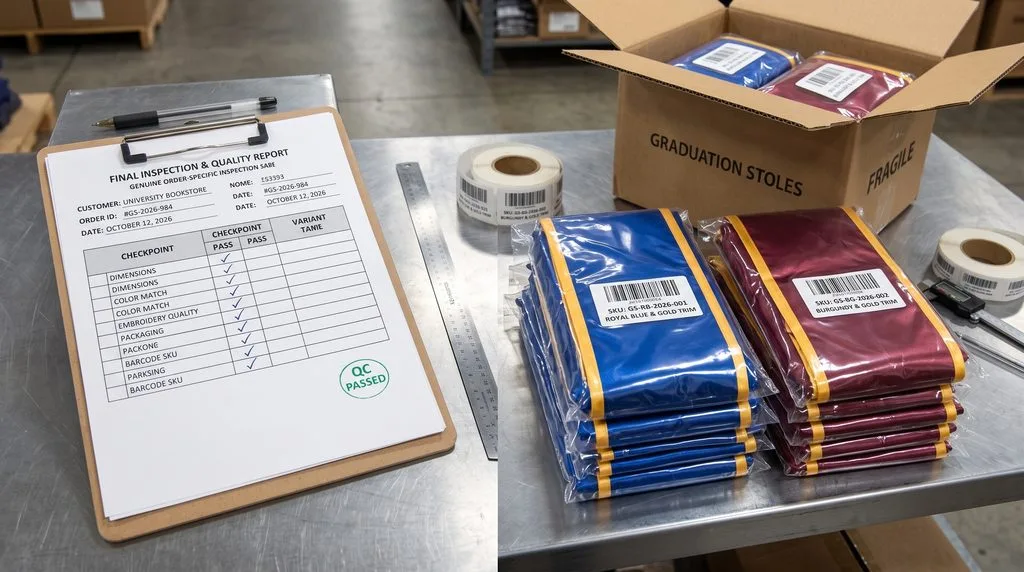
Ask for an order-specific inspection plan rather than accepting “strict QC” as a complete answer. The plan should state what is checked, when it is checked, how samples are selected, which tolerances apply, who can release the order, and what evidence the buyer will receive.
Cover at least five stages:
- Incoming material and color-reference check.
- First-piece check after cutting, printing, or embroidery setup.
- In-process review of seams, decoration, and personalized data.
- Final inspection against the approved specification and sample.
- Quantity, packaging, label, carton, and shipping-mark verification.
Sashesmaker’s About Us and product pages describe multiple inspection stages and checks for artwork, color, stitching, logo position, and packaging. Those are public supplier descriptions, not an independently witnessed inspection system. Buyers should request the checklist, results, photographs, and release criteria for the specific purchase order.
How can capacity and delivery claims be tested?
Capacity is meaningful only when tied to the product, quantity, approvals, and required dates. Ask for the planned start date, daily or weekly output for the proposed process, production line, peak-season constraints, and buffer for correction.
Build the schedule backward from the warehouse receipt date. Separate specification confirmation, artwork review, sample approval, material preparation, production, inspection, packing, dispatch, transit, customs where applicable, and receiving inspection. A production estimate is not the same as a delivered-date commitment.
Ask what happens after late approval, material unavailability, or failed inspection. Require notification rules, revised dates, corrective action, and decision authority.
Which MOQ and quotation details must be normalized?
Compare suppliers using the same specification and delivery scope. Otherwise, a lower unit price may exclude setup, samples, individual names, custom packaging, freight, inspection, or other necessary work.
| Quotation item | Questions to ask |
|---|---|
| Minimum order quantity | Is it per order, style, color, artwork, size, or packaging version? |
| Product price | Which fabric, size, construction, decoration, and quantity tier are included? |
| Setup and samples | Are digitizing, screens, proofs, sample units, or sample freight separate? |
| Packaging | Are individual bags, labels, sorting, and carton marks included? |
| Delivery | Which named location, transport scope, currency, and validity period apply? |
| Exceptions | What is excluded, and how are changes, rework, or replacements priced? |
Sashesmaker’s current public pages state an MOQ of 200 pieces for several stole categories. Treat this as a starting point. Obtain written confirmation for the exact mix of colors, sizes, designs, names, and packaging. Source: Sashesmaker homepage, accessed October 21, 2026.
What should buyers verify about certificates and test reports?
Request only documents relevant to the destination market, buyer policy, and actual product. Check the issuing body, holder name, site, standard, scope, issue and expiry dates, report number, tested sample, and whether the document covers the material or batch being purchased.
Do not confuse a management-system certificate with product certification or a product test. The International Organization for Standardization states that ISO develops standards but does not itself certify organizations or issue certificates; independent certification bodies perform that work. Therefore, an “ISO certified” claim should be supported by the actual certificate and issuing body. Source: ISO Certification.
A report for one sample does not automatically cover other fabrics, inks, trims, or production dates. Ask a qualified specialist which destination-market requirements apply.
Which commercial and after-sales terms should be written down?
The purchase order or contract should identify product specifications, quantity, price basis, payment milestones, approval responsibilities, change control, inspection rights, delivery terms, documents, defect reporting, and remedies.
Define what evidence is required for a claim, how quickly discrepancies must be reported, and who pays for rework, replacement goods, or replacement freight under agreed scenarios. Also address ownership and permitted use of artwork, digitized embroidery files, logos, molds or setup files, photographs, and confidential customer data.
Put every material term in writing, including sample refunds, payment, priority production, exclusivity, and replacements.
What red flags justify a pause?
Pause and investigate when:
- The legal entity, invoice, bank beneficiary, and website identity cannot be reconciled.
- The supplier refuses a measurable specification or changes materials without approval.
- Only unrelated samples are available for a technically demanding order.
- A certificate is cropped, expired, unverifiable, or outside the product and site scope.
- The quotation omits major cost items or delivery responsibilities.
- The supplier pressures payment while artwork, sample, or terms remain unresolved.
- Communication becomes inconsistent when buyers ask about defects or remedies.
A red flag is a prompt for verification, not automatic proof of misconduct. Record the explanation and decide whether the residual risk is acceptable.
How should buyers make the final selection?
Use a weighted scorecard, then validate the leading supplier with a trial order. Score identity, specification control, capability, sample quality, QC evidence, delivery planning, commercial clarity, and communication. Weight categories according to project risk.
Set approval gates:
- Before deposit: identity, quotation scope, specification, payment details, and responsibilities confirmed.
- Before production: artwork revision, physical sample where needed, variation list, materials, and schedule approved.
- Before shipment: inspection evidence, quantities, packaging, shipping documents, and release decision complete.
Scale only after reviewing actual performance. A trial order reveals how the manufacturer manages revisions, personalized data, inspection findings, packing, and schedule changes.
Frequently asked questions
Is the lowest quotation the best manufacturer choice?
No. Compare the cost of the same product, approval process, packaging, delivery scope, and correction terms. A lower quote may simply exclude necessary work or transfer risk to the buyer.
Does a factory video prove manufacturing capability?
No. A current video can support a capability check, but it may not prove ownership, capacity, or use for your order. Combine it with entity documents, process evidence, samples, and a trial order.
Is an ISO 9001 certificate a product certificate?
No. ISO 9001 concerns a quality management system. It does not certify that a particular graduation stole meets a product requirement. Verify the certificate’s holder, issuer, scope, site, and validity.
Should buyers always arrange a third-party inspection?
Not always. The decision depends on order value, complexity, customization, supplier history, and the cost of failure. If used, provide the inspector with the approved specification, sample, tolerances, and packing requirements.
How many orders are needed before increasing volume?
There is no universal number. Increase volume only when sample and trial-order results, communication, corrective actions, and delivery performance provide enough evidence for the additional risk.
What is the next step?
Create a supplier verification file containing the identity check, specification, approved artwork, sample record, itemized quotation, QC plan, schedule, and written terms. Buyers considering Sashesmaker can use its contact page to request order-specific documents, samples, and a quotation. Verify each response against the planned product before selecting a manufacturer or increasing volume.